

Most people walk into the gym with their bag packed and playlist ready, but their head is still somewhere else entirely. The problem is that a distracted mind makes for a distracted workout. Five minutes of intentional prep before you train can shift that completely.
Here’s how to build a routine for yourself. Each step takes about a minute. You can do this in the locker room, in your car before you walk in or standing quietly near your first piece of equipment.
As long as you’re taking the time to complete the ritual, it doesn’t matter when or where it happens.
Step One – Take a Minute to Breathe
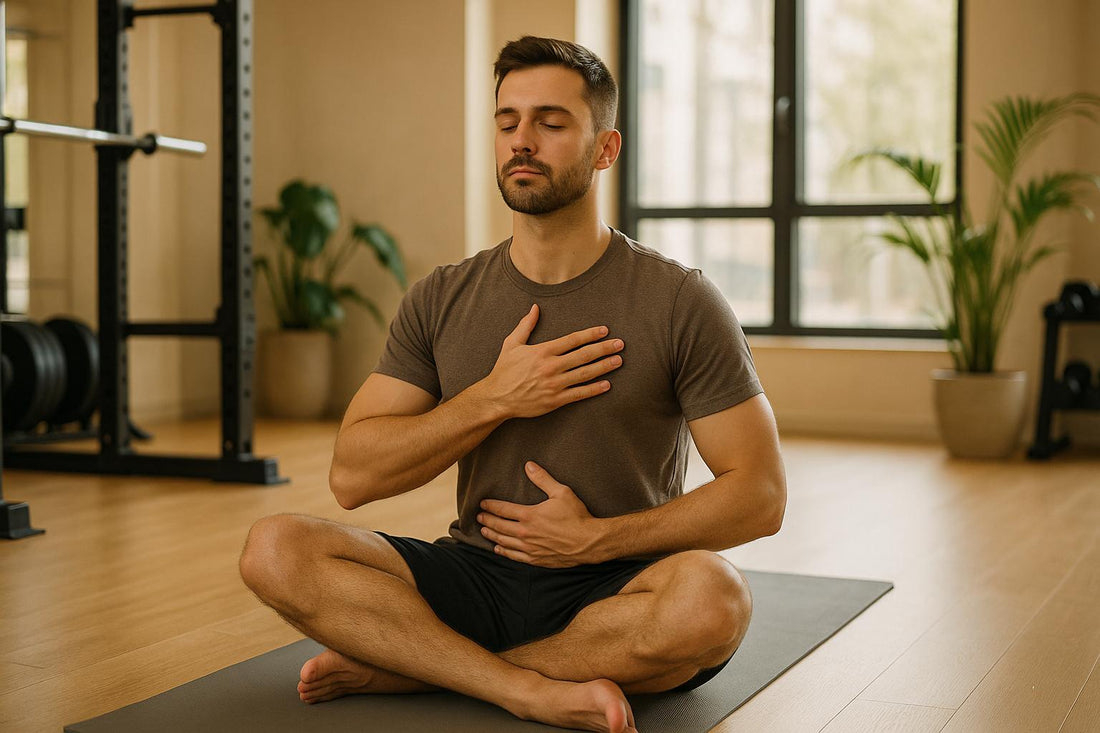
This is the fastest way to shift your mental state, and it works almost every time. Try box breathing by inhaling for four counts, exhaling for four and holding for four. Repeat it three or four times.
If box breathing feels like too much, just take three slow, deliberate breaths with a long exhale. The exhale matters most because it’s what tells your body it’s safe to settle down. One minute of this done with intention does more than most people expect.
Step Two – Set an Intention Rather Than a Goal
Goals are great for tracking progress. However, an intention is different. It’s about how you want to show up, not what you want to achieve.
A goal sounds like “I’m going to hit five sets of squats at my target weight,” while an intention sounds like “I’m going to stay present and move with control today.” It sounds small, but it reorients your focus inward so you stop comparing yourself to whoever’s next to you. Your training for yourself, which is when training actually starts to feel good.
Step Three – Do a Quick Body Scan
Before you pick up a single weight, spend 60 seconds checking in with how your body actually feels today. Scan from your neck down to check for tightness in your shoulders, tension in your hips or fatigue that suggests you need to dial back the intensity.
This is about adjusting intelligently. A one-minute checks costs you almost nothing and can save you weeks of recovery.
Step Four – Visualize One Strong Moment

You don’t need to rehearse your entire workout mentally. Just pick one moment and see yourself doing it well.
Visualization is one of the most well-supported tools for mental performance. Research consistently shows that mentally rehearsing a physical movement activates many similar neural pathways as actually doing it.
Close your eyes for 30 seconds, picture yourself moving with confidence and control and feel what it feels like when things go right. It’s like a warm up for your brain.
Step Five – Build a Ritual Anchor
The most effective pre-workout rituals are the ones that become automatic. The way to get there is to attach them to something consistent.
It could be a specific song you only play when you’re about to train, a particular scent that you associate with focus or a phrase you say quietly to yourself. The point is repetition.
Over time, your brain starts to use that cue as a trigger. This is how pre-workout rituals help you train with intention rather than show up and hope for the best.
Can Pre-Workout Affect Your Brain?

Your mental health shapes everything about how you perform physically, from your focus and effort to your ability to push through when things get hard. When you’re emotionally scattered, your body follows.
While taking a short walk can be enough to improve your mental outlook, carrying that scattered feeling into a workout means tension sneaks into your movement, your form slips, and you go through the motions without really being present for any of it.
There’s a reason athletes at every level talk about the mental side of performance. Your nervous system responds to stress before your muscles ever get the chance to warm up. If you’re walking in anxious or mentally overloaded, your body is already working against you.
When talking about pre-workout affecting your brain, most of the conversation around that focuses on supplements like caffeine, beta-alanine and the like. But the less discussed answer is that your mental state going into a session is its own kind of input. A calm, focused mind primes your nervous system for better responses, mid-workout regulation and precision.
The good news is that you don’t need a meditation cushion or a 45-minute wind-down routine to get there. Five minutes done consistently is enough. Although it might feel strange to complete all these rituals at first, the more you do them, the easier it will be.
Making It Stick
The biggest mistake people make with a routine like this is deciding it has to be perfect to count. Realistically, some days, you’ll get all five steps. Some days, you’ll manage two deep breaths in the parking lot and a single intention before you walk through the door. It still counts.
It even counts if you only remember to do it after your first set and take a brief pause before you complete the rest of your workout. What matters most is the direction.
You’re building a habit of arriving mentally as well as physically. Over time, that compounds. Your sessions feel more deliberate. Your recovery gets easier because you’re not carrying as much lingering stress into each workout. You start to notice when something’s off early enough to adjust rather than push through and pay for it later. Five minutes is a small investment, but the return shows up in every set.
The Warm Up Your Brain’s Been Waiting For

Your gym bag has everything your body needs, and now your mind gets its five minutes, too. The ritual doesn’t have to be elaborate or perfectly executed every time. It just needs to be yours.
Start small, stay consistent and notice what shifts for you. The best workout you’ve ever had could start before you touch a single weight.